


Rail freight to Uzbekistan
When volumes are large and cost outweighs speed
Transit time: 18–35 days
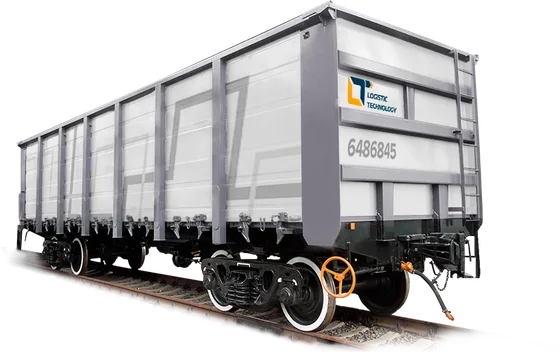
Rail carries what does not pay off on a truck: consignments from twenty tonnes up, raw materials, equipment, containers by the trainload. Uzbekistan is connected by rail to all its neighbours, and from China to Tashkent a wagon travels overland without a single transfer to water. The defining feature of the route is the change of gauge: 1520 mm in Uzbekistan and the CIS, 1435 mm in China and Europe. At the border the train is either lifted onto different bogies or the cargo is transferred into a wagon of the other gauge; both take time, and both are already inside the 18–35 day transit.
How it works
- A covered wagon is the workhorse for packaged and general cargo: about 68 tonnes and 120 cubic metres, twice a truck by volume.
- An open wagon takes bulk cargo, metal, timber and anything loaded from above.
- A container on a flat wagon suits cargo that is already stuffed: 20 and 40 feet, and the same box runs from the factory to your warehouse without the goods themselves being handled.
- A block train runs to a timetable: faster than a single wagon, because the train is not waiting to be marshalled along the way.
- The gauge change on the Chinese border runs through Dostyk and Altynkol: either the bogies are swapped or the cargo is transferred into a 1520 mm wagon. Both are routine; the difference is in price and in two or three days.
- Transit of 18–35 days depending on the country of departure and on whether the wagon travels alone or in a block train.
- The railway carriage charge and the border station services are inside the rate — no separate invoice appears en route.
What we need from you
- The station or city of departure and the destination station in Uzbekistan.
- Weight and volume of the consignment; for bulk and liquid cargo, the commodity as the railway classifies it.
- What we load: a covered wagon, an open wagon or a container. If you are not sure, we advise from the cargo.
- Readiness of the cargo and whether the shipper has a rail siding.
Trade lanes
China
Cargo from China to Uzbekistan
Russia
Cargo from Russia to Uzbekistan
Kazakhstan
Rail freight from Kazakhstan to Uzbekistan
South Korea
Rail freight from Korea to Uzbekistan
Europe
Cargo from Europe to Uzbekistan
Iran
Rail freight from Iran to Uzbekistan
Turkmenistan
Rail freight from Turkmenistan to Uzbekistan
Tajikistan
Rail freight from Tajikistan to Uzbekistan
Why clients choose us
Something to compare with
This is not the only way: on the same route we also price road, air and container. We show the trade-off in cost and time.
Customs handled
We select HS codes, calculate duties up front and run release through a licensed customs broker — you need not find one yourself.
One contract
We are accountable for the whole route, not just one leg of it.
Cargo insurance
Full loads and groupage insured at the client’s request.
Groupage cargo
We accept from a single pallet — no waiting for a full truck.
Status without chasing
We tell you where the cargo is before you have to ask.
How we work
-
1
Request
You send the cargo, route, weight and volume — by form, Telegram or phone.
-
2
Quote
We price the options by mode and send you a rate with transit times.
-
3
Contract
Times and cost are fixed in writing, paperwork is prepared.
-
4
Transport
We collect the cargo, run the route and keep you posted on status.
-
5
Customs and delivery
We take the cargo through customs with the broker and deliver it to your warehouse.
Frequently asked questions
Why is rail slower than road over the same distance?
Borders and marshalling. A single wagon waits to be attached to a train going its way, and where the 1435 and 1520 mm gauges meet the train is lifted onto other bogies or the cargo is transferred. A block train is faster because it does not wait to be marshalled.
At my volume, is a wagon or a truck cheaper?
As a rule of thumb by volume: from roughly 60–70 cubic metres a wagon usually wins, below that a truck is better. But the sum has to be done for the actual route: the cargo still has to reach the station and be collected from it.
Do I need my own rail siding?
No. Without a siding the wagon is unloaded at the station goods yard and the cargo reaches your warehouse by road — that is part of the route, not a separate service.
Can cargo travel by rail in a container?
Yes, and from China it is the usual choice: the container goes on a flat wagon and the goods inside are not handled once before your warehouse. At the gauge change it is the container that is transferred, not the cargo.
Do you run rail freight inside Uzbekistan?
No. We are an international carrier: the wagon comes from another country. We do not run domestic transport.
How long does transit take?
Typically 18–35 days depending on the origin, border queues and cargo type. The exact transit time is fixed in the contract.
Do you take groupage cargo?
Yes, we accept from a single pallet — no need to wait for a full truck load.
Who handles customs?
We arrange it: we pick the HS code, calculate the duties in advance and run the release through a broker. You do not need to find a declarant — we answer for the timing and the amount.
Can the cargo be insured?
Yes, we insure both full loads and groupage at the client’s request.
Request a freight quote
Describe the cargo and the route — we come back with a rate and transit time.